
AUGUST 2026 Essay:
From Sauna to Summit:
Tackling California's Hotter Future

BY ENRIQUE HUERTA, SENIOR DIRECTOR, POLICY & LEGISLATION
Wondering why this summer feels like a steam room? You’re not imagining it.
The Pacific Ocean is currently running a fever with water temperature well above normal. When the ocean heats up, it stops acting like an air conditioner and starts resembling a sauna. Warming ocean temperatures increase coastal humidity which further traps heat over LA neighborhoods, making hot spells last longer and feel stickier.
Understanding major shifts in weather are essential in helping to develop solutions. This is why Climate Resolve is co-producing the upcoming Resilient California Summit, October 20 to 22, in Sacramento. Joining the Governor’s Office of Land Use and Climate Innovation, California Natural Resources Agency, Farallon Strategies, and Indigenous Futures Society, this major event will highlight cutting-edge research from California’s Fifth Climate Change Assessment, featuring over 90 special panels and 120 poster sessions.
But this is not some stuffy scientific conference. Far from it. The speakers are Californians who have been in the field. The Summit is all about doers. The focus is on action. And you’re invited.
Organizing a mega climate summit takes immense resources. If you cannot attend the Summit, I hope you can make a donation to Climate Resolve. Doing so will enable our small plucky nonprofit to continue leading statewide partnerships, and help us translate good science into action. Help us do our job of protecting communities across California.
JULY 2026 Essay:
More Than Emergency Response - Resilience Starts Before the Fire
BY CAT BALTAZAR, ASSOCIATE DIRECTOR OF ADVOCACY & ORGANIZING
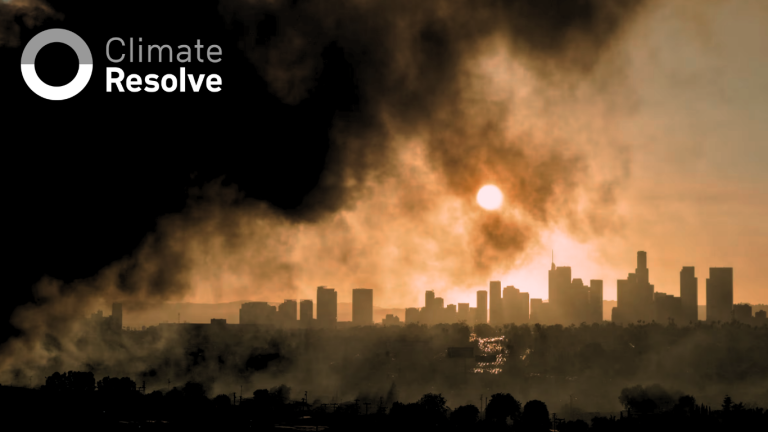
Boyle Heights and neighboring communities are still navigating the uncertainty brought on by the Lineage Fire. The fire is out, and the smoke has cleared, but rotting food in soaring air temperatures has intensified foul odors and attracted swarms of disease-spreading pests.
Families worry about the air they breathe, the safety of their homes and businesses, protecting their loved ones and pets, and the long-term health impacts. Workers and businesses have been disrupted, and residents want answers about what comes next.
It is in moments like these that the strength of a community becomes visible. Across the Eastside, community-based organizations, advocates, and volunteers have stepped up to support their neighbors. Proyecto Pastoral and Promesa Boyle Heights connected residents with emergency financial assistance, while Inner City Struggle and Boyle Heights Arts Conservatory distributed masks, air purifiers, and other essential resources.
Navigating resources across agencies and jurisdictions is challenging, making trusted community organizations invaluable in helping residents access support. These efforts also reflect something deeper: long before this fire, community leaders and residents had been building the trust that helps communities navigate challenges together.
Communities rarely experience environmental hazards in isolation. The Lineage Fire adds to the cumulative environmental burdens Boyle Heights and East Los Angeles residents have lived with for decades, including pollution from nearby freeways, rail corridors, and industrial activity. Addressing this requires more than emergency response; it requires sustained investment in people and partnerships to make long-term resilience possible.
My role has been to partner with residents and community organizations to translate that vision into long-term planning and policy solutions. Through the Boyle Heights Industrial Buffer Zone, community members identified a vision for healthier neighborhoods by reducing incompatible land uses, expanding tree canopy and shade, improving air quality, and investing in infrastructure that reflects community priorities. Those recommendations became a community-driven plan to improve neighborhood conditions and guide future investment.
Today, that work continues through our community air quality monitoring program with Promesa Boyle Heights, Clarity Movement Co., and our Community Advisory Committee. Air quality monitors can tell us what is in the air, but not the whole story. Residents bring lived experience that gives data context, creating a fuller understanding of neighborhood conditions that guides future planning and strengthens community advocacy.
Residents deserve transparency, accountability, and sustained support through recovery, and a voice in the long-term decisions that shape their neighborhoods’ health. Resilience grows from the knowledge, relationships, and leadership communities have built over generations. The role of climate planning is to invest in that existing capacity, so residents remain in their neighborhoods to shape, steward, and benefit from the future they’ve long been building toward.
If you’d like to support the ongoing recovery, consider contributing to Proyecto Pastoral’s Lineage Fire relief fund, which provides direct financial assistance to impacted families in Boyle Heights.
JUNE 2026 Essay: WHEN SUMMER WAS COOL
BY JONATHAN PARFREY, EXECUTIVE DIRECTOR
I used to love summer. I still do – but this glorious season has changed.
Remembering back to school days, summer meant playing baseball in the park until dark. Summer meant visiting my grandparents in Sharon, a historic small town in western Pennsylvania where summer days felt endless.
Later, as a parent, summer meant family vacations – car trips with our four children. We frequently traveled from LA to Southern Colorado and car-camped in the Sierra Nevada. In those pre-cellular days, these long drives were made lighter by singing dumb songs and playing trivia games.
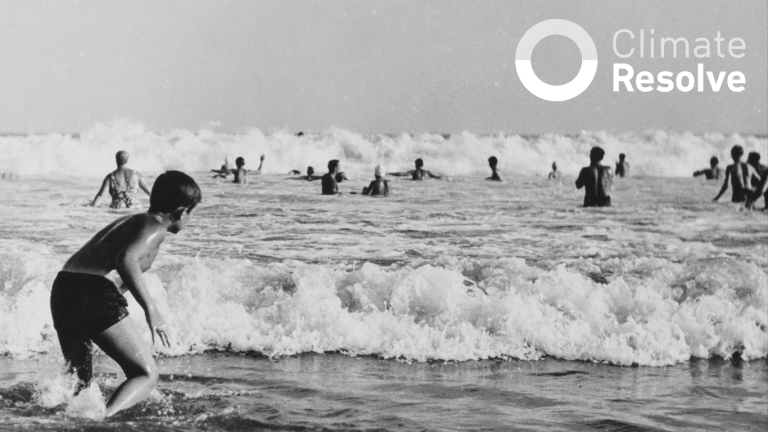
Summer also meant trips to the beach. The beach is nothing less than LA’s natural air-conditioner.
In olden days, Californians would also escape the heat by heading into the mountains. In the 1890s, Angelenos would take the Mount Lowe Railway, an electric funicular, from Altadena to campgrounds and chalets 5,000 feet above sea level. One of my favorite hikes follows the railway’s old route where remnants can still be seen.
Californians are still searching for refuges from heat. This month, I attended a lecture by USC Sea Grant on the dual issues of beach access and extreme heat. Researchers suggest that sea-level rise, combined with the damming of streams that once replenished coastal sand, will result in the narrowing of beaches, reducing space for beachgoers to cool off.
It seems that climatic conditions – heat, fire, and sea-level rise – keep bumping into each other.
Don’t get me wrong, summer is still wonderful. I love the long sunny days with insects buzzing in the garden.
In key ways, Climate Resolve is working to protect summer – the Earth in its brightest phase.
Our organization is pursuing ambitious solutions. For example, we’re shaping how the State of California addresses heat waves. We are currently organizing a major global campaign to curb the Earth’s energy imbalance. We’re innovators in zero-carbon transportation. We’re working to limit the ferocity of wildfires.
We’re taking big swings because we want to make a difference.
May 2026 Essay: Chernobyl 40 Years Later
Choosing Reliability Without the Radioactive Legacy
BY BEN VERHEIDEN, GRANT WRITING & ADVOCACY INTERN
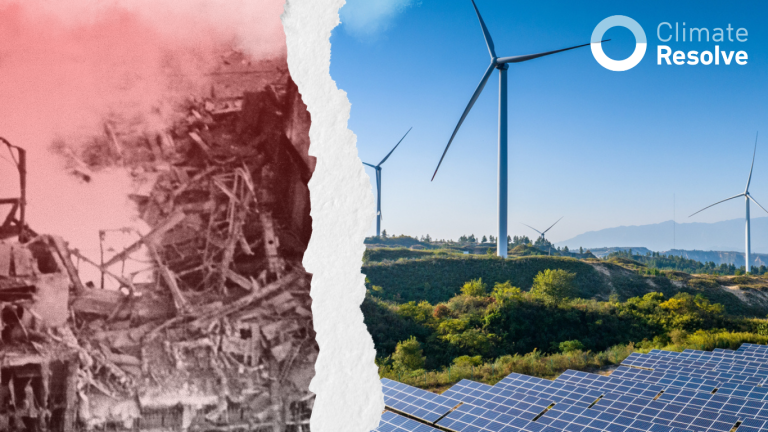
Last month marked the 40th anniversary of the Chernobyl nuclear accident. Forty years later, the enduring exclusion zone and the accident’s massive economic and human toll serve as a sobering reminder of the complex, long-term challenges involved in managing nuclear energy and long-lived radioactive waste.
As California evaluates its future energy mix, we think it’s important to remember Chernobyl, especially now that several bills seeking to revive the state’s nuclear industry have been introduced.
This nuclear revival is occurring as safer, less-expensive renewable options, such as solar and wind, supported by Battery Energy Storage Systems (BESS), are being rapidly and globally deployed.
We’re seeing the value of renewable power in real-time. Last year, at the United Nations Climate Change Conference in Brazil, Governor Newsom announced that California’s battery storage has surged to nearly 17,000 MW—a 2,100% increase since 2019—reaching one-third of the capacity needed to achieve the state’s 2045 clean energy goals. This buildout proved critical during the record-breaking heatwaves of 2022, when these systems successfully stabilized the grid and prevented the kind of costly, deadly blackouts that once threatened our state.
Renewables effectively compete with both fossil and nuclear power while delivering better environmental outcomes.
The Chernobyl disaster should have ended the debate on nuclear power 40 years ago. The Fukushima disaster should have been the exclamation mark. To ensure a thriving future for our state, let’s commit to advancing cleaner, safer energy innovations.
April 2026 Essay: The New CLUB MED
BY JONATHAN PARFREY, CLIMATE RESOLVE EXECUTIVE DIRECTOR
Let’s imagine a vacation along the Mediterranean Sea.
From a cliff high above the shore, you can see this beautiful, vast turquoise sea. As the sun sets, you walk a path back to your pensione. The walk is made lighter thanks to the cool evening breeze.
As a Californian, it’s easy to imagine this Mediterranean idyll precisely because Los Angeles is a mediterranean city. (Mediterranean with a small m.). Our city is located along the 34th Parallel, the same latitude as Cyprus – or for that matter, the same latitude as Tangier, Morocco, Adelaide, Australia, Santiago, Chile, and Cape Town, South Africa.
All of these mediterranean regions share common attributes. First, they’re all wonderful places to visit – vacation hotspots. Second, they are hugely important agricultural centers. Third, they’re home to major cities and trading.
These mediterranean regions share common threats as well. California and Chile have earthquakes. All these lands are currently experiencing bad impacts from massive wildfires, severe drought, and extreme heat waves.
Enter Wade Crowfoot, Secretary of the California Natural Resources Agency. Three years ago, I happened to be with Wade in Sydney, Australia, attending a meeting with representatives of the New South Wales government. I saw the proverbial lightbulb go off over Wade’s head when he said that mediterranean states and provinces should come together to discuss common climate threats.
The Mediterranean Climate Action Partnership (MCAP) was conceived shortly thereafter. The MCAP today consists of 16 subnational governments across five continents.
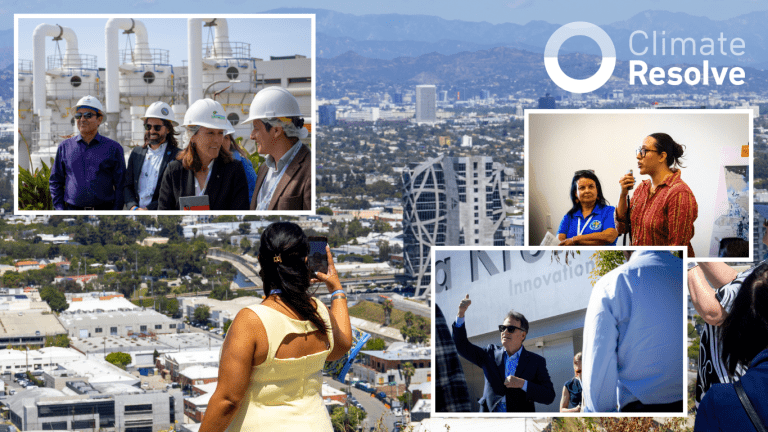
In April, MCAP delegates met in Los Angeles – and Climate Resolve helped organize the group’s many site visits, working with the Resources Agency and Resilient Cities Catalyst, the Partnership’s secretariat.
The delegation visited such sites as the Baldwin Hills Scenic Overlook, LA Cleantech Incubator, Exposition Park, Eaton Canyon, Jackson Magnet Elementary in Altadena, Destination Crenshaw, SoFi Stadium, and the Hyperion Water Treatment Plant.
They saw what LA is doing about stormwater capture, water recycling, permeable and cool pavement, depaving asphalt streets, replanting native plants, recovering from fire, and how we’re working with youth to create new jobs and build community.
Globally, more than 600 million people call the mediterranean climate zone home. Leapfrogging over federal intransigence on climate action, our team shared local solutions with localities across the globe.
It was an honor for Climate Resolve to facilitate new understandings – sharing LA’s best practices and ambitions – while learning new practices from kindred leaders.
March 2026 Essay: Subterranean Blues
BY JONATHAN PARFREY, EXECUTIVE DIRECTOR
There’s a trick.
When it comes to figuring out which human activities are making Earth a hotter place, there’s a surprisingly useful shortcut.
If an activity involves using materials pulled from deep underground – like coal, oil, and gas – it is very likely contributing to climate change. By contrast, if it depends on energy or materials already circulating on Earth’s surface, it’s much less likely to do so.
Here’s why.
Hundreds of millions of years ago, coal, oil, and gas began as living things on Earth’s surface, mostly as algae. Over vast stretches of time, those little carbon bodies sank to the bottoms of oceans and lakes, accumulating layer upon layer. They were then seismically stirred up, buried, and then compressed by immense pressure, transforming the fossilized bodies into coal, oil, and gas.
For the past two centuries, these long-dead things have been dug up, refined, and burned in furnaces and combusted in automobile engines. In doing so, these transformed carbon bodies that were locked safely underground have found a new home in the atmosphere, where they trap heat by quite efficiently reflecting it back to Earth and overheating our planet in the process.
Visit the La Brea Tar Pits, where oil has seeped up from the ground for tens of thousands of years, and you can smell the hydrogen sulfide attached to methane released by bacteria breaking down oil in the pits. One whiff is enough to make the point: some things are better left underground.
Climate scientists have shown with unwavering certainty that loading our atmosphere with carbon from old fossils is dangerously overheating our planet, with devastating consequences. So, isn’t it time to move on from the main source of climate pollution?
Let’s leave subterranean fossils where they are. Better alternatives – power from wind and the sun – are here now and abundant.
October 2025 Essay: Why We fight
BY JONATHAN PARFREY, EXECUTIVE DIRECTOR
A few weeks ago, I attended Climate Week in New York City.
If you’ve never been, dozens of events are held for five consecutive days. While there is a Hub, hosted by the event organizer, The Climate Group, the truth is that Climate Week is an anarchistic affair with sessions scattered throughout the city.
Some sessions are large. Some events are small. Some are organized by nonprofits. Some by agencies. Some by companies. While many meetings are open to the public, some events are more exclusive – you’ve got to know someone.
One such meeting was the Risk and Resilience Summit held at Aon headquarters. Imagine a large conference room on the 43rd floor of a sleek New York City office building. Then imagine one hundred chairs filled. Add folks standing along the walls and back against the glass windows overlooking the World Trade Center and its memorials.
I swear I was the only nonprofit slob in the room. I was surrounded by businesspeople from Wall Street, from the insurance industry, from the ratings agencies, and loads of investment bankers. What I heard from the stage was this:
“We cannot ignore climate change; the massive changes in weather entail so much financial risk that we cannot ignore it; we would fail as fiduciaries, fail our clients, fail our investments, if we do not take climate change seriously.”
The previous day, President Trump told the United Nations General Assembly that climate change was a hoax. Talk about cognitive dissonance. Above the World Trade Center, I heard a very different story – the titans of the American economy cannot permit the indulgence of unreality. Facts are facts – and you lose money when you fail to deal with facts.
At another session, at the Explorer’s Club on the Upper East Side, Jonathan Granoff, President of the Global Security Institute, pleaded with climate advocates to communicate not just the “what” and “how” of climate solutions, but also include the “why.”
“We need to lean into a values conversation,” Granoff said while promoting a Golden Rule for the 21st Century: “treat the lives and well-being of future generations as we wish to be treated.”
These two concepts – one from the business community and the other from an ethicist – may appear at odds. But I don’t think so.
At Climate Resolve, we do our work because the global climate crisis is real – as in really real, as in I wish it weren’t really real. The lives and well-being of this generation – and those following – will be affected by our actions today.
And this is why we fight.
September 2025 Essay: Avoiding Maladaptation
BY ENRIQUE HUERTA, LEGISLATIVE DIRECTOR
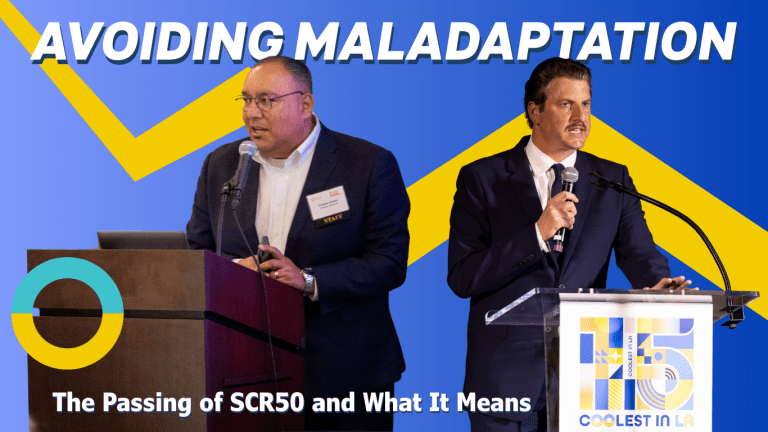
Chalk up another legislative win. Senate Concurrent Resolution (SCR 50), authored by Senator Henry Stern and sponsored by Climate Resolve, was approved by the California legislature this summer.
SCR 50 tasks the Governor’s Office of Land Use and Climate Innovation with developing a clear policy framework on maladaptation and working with state agencies on how to avoid it.
Adapting California to our changing climate is absolutely crucial. The Eaton and Palisades fires demonstrated that California is not ready for the change.
Today’s funding for resilience and adaptation is a drop in the bucket compared to the need.
A 2024 study by the Center for Climate Integrity conservatively estimated that Los Angeles County alone will require at least $12.5 billion through 2040 to adapt to climate change.
We know that every dollar spent in averting disaster saves $13 in avoided damage, cleanup, and lost economic activity, according to the U.S. Chamber of Commerce.
The Eaton and Palisades fires are costing us around $250 billion in damages. Indeed, we are paying a steep price for our short-sightedness.
SCR 50 helps the state act more intelligently with its resources by providing a framework to evaluate whether its investments are positioning California for greater resilience.
August 2025 Essay: STAYING HEALTHY IN A WARMING CLIMATE
BY MARC FUTERNICK M.D., BOARD MEMBER
When 72-year-old Robert Woolley tripped outside his Phoenix home on a hot summer day, searing hot rocks gave him third-degree burns on 20% of his body.
A simple fall turned into a life-threatening emergency.
As the Earth grows hotter – and Southern California within it – how do we protect ourselves and our loved ones from the dangers of extreme heat?
When it’s very hot, our internal temperature rises, and we feel bad just as we would with a fever.
High body temperature can result in heat stroke, the signs of which include confusion, slurring of words and imbalance. This is a medical emergency that requires immediate treatment with rapid cooling, such as an ice bath.
If our internal temperature continues to rise, our organs will begin to fail. If we don’t cool down, we will die.
There are two main ways we cool our bodies. We can go to a cooler place, such as an air-conditioned room, or, if we can’t get into a cool space, our body’s answer is to perspire.
Perspiration is what happens when we sweat, and then sweat evaporates into water vapor. Evaporation cools the body. This process is very effective. Without perspiration, we would be unable to naturally cool our bodies when the outside temperature is above 99 degrees F.
When it’s dry, our sweat evaporates easily, but when it’s humid, evaporation slows down, and our body cools much more slowly. This is why the Heat Index, which combines humidity and temperature, is a better measure.
It’s far better to prevent heat illness than to treat it. How do we do that? It starts with knowing the Heat Index, which informs us about the risk that day. We can plan our activities for cooler times or places. We can cool down by applying ice, drinking water, and seeking out shade. Most importantly, we can check on those who can’t ensure their safety, such as small children and people with disabilities or cognitive impairment.
There are broader public health solutions as well. We can deliver water to the unsheltered. We can proactively limit students’ exposure to heat during PE. We can improve shade and water availability in our public transportation system. We can plant shade trees, which also cool the air through transpiration.
As a community, we can even go further upstream by by deploying reflective surfaces. When we reflect more of the Sun’s energy back into space, rather than absorbing it through our built environment, our city stays cooler. This is achieved most efficiently with cool roofs, utilizing reflective coatings and shingles. Additionally, we can construct cool walls, roads, and parking lots, and enhance the reflectivity of other areas that traditionally absorb sunlight.
Reflecting more of the Sun’s energy back into space will also help correct the Earth’s energy imbalance, the dynamic behind climate change. Of course, the most essential medically indicated treatment is to stop burning fossil fuels in the first place.
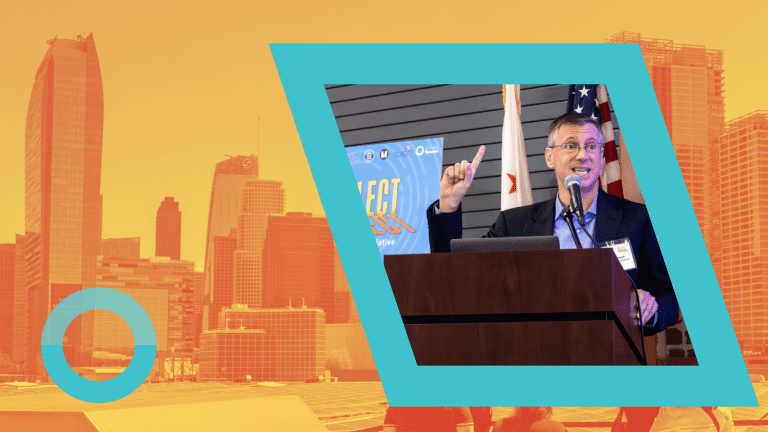
Watch Dr. Futernick’s presentation at The Reflect Effect last month.
JULY 2025 Essay: THE REFLECT EFFECT
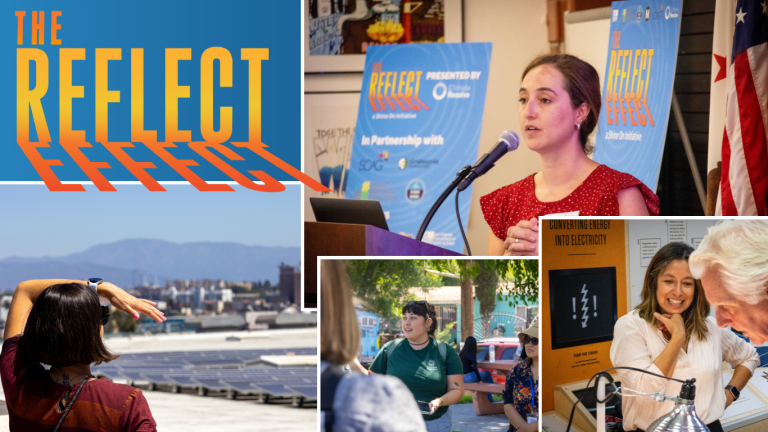
Last week, Climate Resolve hosted The Reflect Effect, an opportunity to connect people critical to advancing the science, policy, investment, and deployment of cool surfaces.
Advocates, researchers, and city public works and sustainability officials from around the country came to Los Angeles to hear from the experts.
The Cool Roof Rating Council and the Smart Surfaces Coalition shared the current state of cool materials—roofs, walls, and pavements that reflect more of the sun’s energy than traditional construction materials—and how they work.
The NASA Jet Propulsion Laboratory highlighted the most advanced methods for measuring changes in albedo at a global and fine-scale resolution.
City officials from Phoenix, Los Angeles, and San Antonio shared their progress on cool roof and pavement implementation.
Best of all, we then left the conference room and entered the real world – including the roof of the LA Convention Center – to experience these solutions in action and to hear from the people they benefit. The event underscored the importance of this work and why we need to move quickly to bring it to more communities.
Cool surfaces are a unique solution that delivers a wealth of local benefits while also contributing to global climate change mitigation. Historically, cool surfaces have been mostly valued for their local benefits, including reduced indoor and outdoor air temperatures and the corresponding health benefits, lower cooling demand, and improved thermal comfort during power outages.
But implementing cool surfaces can have global implications by increasing the amount of solar radiation that is reflected back to space, rather than absorbed in the atmosphere or on the ground in our cities. This video, from Bill Nye “the Science Guy” and Climate Resolve, explains the science.
We are living in an unbalanced time. Efforts to address climate change – transitioning to renewable energy generation, driving towards net-zero buildings and decarbonization, and improving energy efficiency – are primarily focused on ways we can reduce greenhouse gas emissions. Just over 96% of the $1.9 trillion in funding and investment for climate change-related projects is headed to these types of GHG mitigation efforts.
These efforts are critically important, but the science and the seemingly daily news of climate disasters make it clear that we have entered a reality demanding immediate solutions to help people adapt, survive, and thrive in a warming world.
We simply cannot choose one climate strategy over the other – we need more of both to meet the moment.
In many ways, The Reflect Effect reminded me of a convening Climate Resolve hosted several years ago to highlight the work Los Angeles had done on cool pavements attended by sustainability staff from more than half a dozen cities across the country, which spurred a flurry of pilots and new research in many of the cities that came and has accelerated progress on cool pavements in the intervening years.
The dialog and energy at The Reflect Effect left me feeling confident that it will spur a similar jolt in progress for fully valuing cool surfaces for the local adaptation and global mitigation solution they are.
JUne 2025 Essay: Blue Ribbon Prescription for Survival
BY JONATHAN PARFREY, EXECUTIVE DIRECTOR
On June 20, the Los Angeles County Blue Ribbon Commission on Climate Action and Fire-Safe Recovery released its final recommendations. The recommendations include essential actions to help LA recover from the January fires and protect against future climate-driven fires.
I served as a member of the Commission. The last three months were a whirlwind of intense labor.
Now that this work is complete, the even harder work begins.
I’m left with this question: how do we convince our neighbors these protective measures require funding? For example, the Commission sees enormous value in establishing a buffer zone of water-nourished “wet” oak trees that would do a great job capturing embers, thereby preventing chaparral-borne fires from entering urban neighborhoods. Yet, a miles-long wall of trees will require water – and that water must be paid for – as would the pipes and pumps and workers required to deliver the water.
While FEMA says that every dollar spent on disaster prevention saves $6 in future costs, I suspect we’ll need better arguments than that – slogans that seem immediate and emotional and self-interested.
I could use your help to solve this dilemma. Please write to me with your ideas.
Credit for the Commission (and our substantive report) must go to Supervisor Lindsey Horvath. Los Angeles owes her our thanks. Also, big kudos to Commission Chair Matt Petersen whose tireless energy and good spirit got the job done. I was also honored to be in the company of nineteen superbly wise commissioners. Lastly, thanks go to the UCLA Luskin Center for Innovation, UCLA Grand Challenge and UCLA School of Law for their intellectual contributions.
Read this smart and helpful report. It’s worth the time!
JUne 2025 Editorial: Climate Resolve Stands
with Immigrant Communities
It has been 20 days since immigration authorities launched coordinated raids across Los Angeles. From schools to worksites, fear has loomed – sparking widespread outrage, protests, and an unprecedented (and illegal) federal response. At Climate Resolve, we acknowledge the pain, violence, and grief our communities are enduring. At the same time, we honor the resilience, joy, and love that bring people together when they stand up against social injustice.
Climate Resolve’s main task is to work to connect communities, organizations, and policymakers to address the global crisis of climate change. Today, we are writing to highlight the critical connection between climate and immigration. Immigrants make up 33% of Los Angeles’ population. They are not only vital to the life and labor of our city; they are part of the very foundation of this region and the nation. Many immigrant communities in Los Angeles are on the front lines of climate change, populating the regions where extreme heat, the deadliest aspect of climate change so far, will be experienced most acutely.
The Department of Defense has acknowledged that climate change poses a significant security risk. Yet, today, federal priorities are skewed: taxpayer dollars are being spent on raids – using racial profiling – arresting immigrants.
This is a moment of unprecedented government overreach. Fear walks our streets, turning vibrant neighborhoods into ghost towns. America’s worst angels have been let loose. Wouldn’t these many millions of dollars be better spent investing in disaster preparedness, especially in the face of the terrible fires we experienced in January?
Indeed, we must dedicate resources to help those without means rebuild homes lost to the fires. We must use our common resources – our tax dollars – to build back safer and cooler, like building well-designed bus shelters, placing cool roofs on top of our homes, and coating our streets with reflective surfaces to reduce the urban heat island effect.
Climate Resolve stands with our immigrant communities. We stand for climate justice, and stand for a future where both people and the planet are protected.
May 2025 Essay: Housing is a Climate Solution—
But Only if We Get It Right
BY CATHERINE BALTAZAR, SENIOR POLICY ANALYST & ORGANIZER
In Los Angeles, the urgency of the climate crisis and our worsening housing crisis are colliding. But what if we told you that the solution to both could—and must—be one and the same?
Housing is a climate solution. Where and how we build housing influences our greenhouse gas emissions, energy use, and access to sustainable transportation. But more than that, the way we invest in housing determines who gets to thrive amidst climate change—and who is left behind. That’s why we must push for intersectional, innovative solutions that treat housing not just as shelter but as an investment in a just and climate-resilient future.
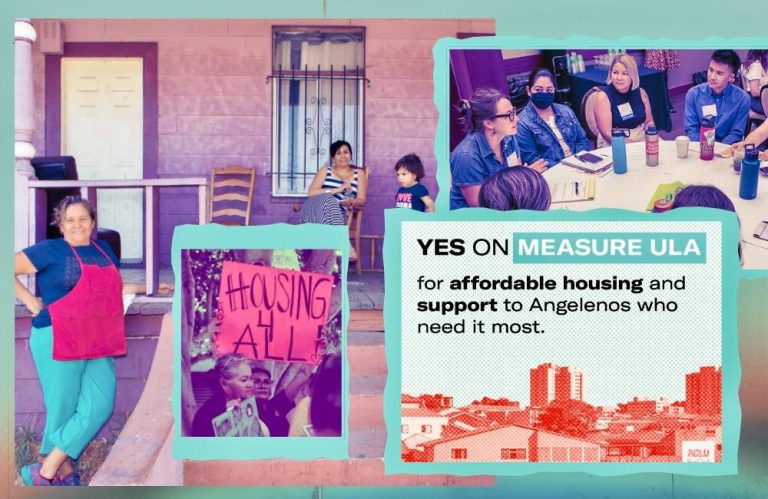
Thanks to the leadership of tenant organizers, advocates, and community coalitions like Our Future LA (OFLA), the City of Los Angeles has already laid a powerful foundation with Measure ULA. Since its implementation in April 2023, the ULA “mansion tax” has raised $661 million, created over 10,000 union construction jobs, supported 795 new affordable housing units, and prevented 11,000 Angelenos from falling into homelessness through direct financial aid. With more than 100,000 tenants reached through public education efforts, ULA is not just a housing policy. As the only meaningful local funding source for affordable housing production in the City of LA – it’s a lifeline. Measure ULA proves what’s possible when we invest in people and community well-being, all while ensuring transparent implementation through a Citizen’s Oversight Committee.
Now, it’s time to bring this same bold vision countywide.
Earlier this year, voters passed Measure A, which authorized the creation of the Los Angeles County Affordable Housing Solutions Agency (LACAHSA). This new agency—also born from grassroots power and led by the OFLA coalition—has a chance to transform how we build, preserve, and protect housing across our entire region. But the opportunity is only as powerful as our commitment to getting it right.
LACAHSA must prioritize:
- The construction of deeply affordable, climate-resilient social housing—permanently affordable homes designed with resident governance, income-based rents, and protections against speculative displacement.
- The preservation of Naturally Occurring Affordable Housing (NOAH)—to protect existing lower-income tenants from eviction and prevent displacement from rising rents.
- A countywide Right to Counsel program—so no one is forced into homelessness simply because they couldn’t afford a lawyer.
- Direct rental assistance and holistic legal services for residents precariously housed or facing economic hardship to preempt what could otherwise turn into a crisis.
- Streamlined, single-source financing to reduce construction timelines and ensure deeper affordability in every unit built.
This focus is not just about funding housing development. It’s about building an equitable Los Angeles County where no one pays more than 30% of their income toward rent, where Black and Brown communities are no longer pushed out, where low-income residents can live safely and with dignity, and where our climate investments don’t come at the cost of our people.
Affordable housing is climate action. Tenant protections are racial justice. Public investment is resilience.
With Measure ULA as our blueprint and LACAHSA as our next chapter, we have the tools to build a future where housing is not a privilege but a guaranteed right. Now, we must ensure that the future reaches every corner of our county.
Let’s build it together.
February 2025 Essay: The Vast Scope of the Damage
BY KRISTOPHER ECLARINO, SENIOR TECHNICAL MANAGER
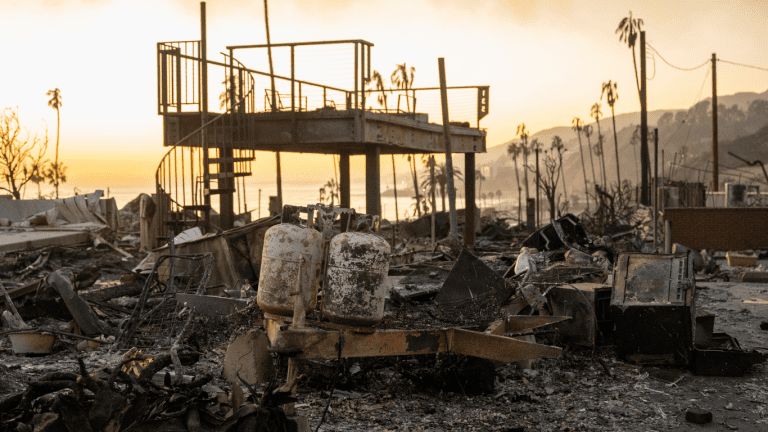
We know the story by heart – on January 7, fueled by powerful winds and dry conditions, the Eaton Fire consumed more than 14,000 acres and destroyed 7,000 homes and buildings in Altadena, Pasadena, and Sierra Madre.
At the same time, the Palisades Fire scorched over 23,000 acres and destroyed 10,000 houses and businesses across Pacific Palisades, Malibu, and unincorporated sections of the Santa Monica Mountains.
How does one grasp the vast scale of damage that took place – as well as understand the unprecedented effort it will take to recover and rebuild? The comparison that came to mind was that of the World Trade Center (WTC) towers, destroyed by a terrorist attack in September 2001. The damage, then, was 10 million square feet (ft²), 5 million ft² per tower.
First, let’s caveat the differences. 9/11 was an act of war. The wildfires were not. The winds also behaved differently. In Palisades, the winds (at least at first) blew massive clouds of ash out to sea. A couple days later the wind returned, bringing smoke back into the LA basin. Altadena’s ash blew south towards Long Beach. In New York, the winds blew towards Brooklyn. Another distinction, the materials from the WTC towers were largely concrete dust, substantively different from the plastics and wood that comprise LA-area homes. Moreover, the WTC towers were local to the Financial District, while the recent wildfires spread over 60 square miles.
Using the most recent CAL FIRE Damage Inspection Data for both Palisades and Eaton fires and overlapping with data from LA Assessor parcel data, we have found that 85% of homes burnt were built before 1980 (5,645 homes destroyed by the Eaton Fire and 4,265 homes destroyed by the Pacific Palisades Fire). We cite pre-1980 data because lead-based paints, asbestos-containing insulation, and other hazardous materials were then commonly used in homes.
When structures containing asbestos or lead-based materials burn, there is the potential for hazardous debris to become airborne and spread across large distances. A 2024 study examining the long-term impacts of wildfire smoke exposure in California estimated that particulate matter from fires between 2008 and 2018 contributed to 52,000 to 56,000 premature deaths.
Beyond the physical health impacts, these catastrophic fires have introduced many Angelenos to a phenomenon called “solastalgia”—a form of emotional or existential distress caused by environmental change. Unlike nostalgia, which involves longing for a place you’ve left, solastalgia refers to the grief and anxiety felt when the place you live in changes dramatically around you. Residents of Altadena, Pacific Palisades, and many Angelenos are experiencing this distress as they return to neighborhoods rendered unrecognizable, with familiar landmarks, cherished trees, and community spaces reduced to ash.
While scientists from UCLA, Harvard, and the University of Texas are currently monitoring airborne and soil contaminants, we are concerned that there is no coordinated, systematic approach to air, soil, and water sampling.
A silver lining – Dr. David Eisenman, a Climate Resolve advisory board member, was recently named Chair of the UCLA Health Wildfire Steering Committee. With his leadership, he may help persuade LA County to adopt a more analytical approach. Akin to the WTC tragedy, Dr. Eisenman is launching a Wildfire Registry to enable researchers to investigate the long-term health impacts of wildfire exposure, including respiratory, cardiovascular, and mental health effects.
The bottom line – the total burnt aerosol material (pre-1980) for both fires is approximately 19,226,000 ft², approximately double the amount of toxic materials released by the collapse and burning of WTC towers. When adding post-1980 homes, the total square feet aerosolized is 24,899,575 ft².
That’s approximately 2.5 times the square feet destroyed in the WTC tragedy.
We’ve got our work cut out for us.
January 2025 Essay: Rebuilding with Intention
December 2024 Essay: Time to Come Home
November 2024 Essay: Resolved. Still.
In the days immediately following the election, many organizations started using the word “resolve” in their communications. It’s an apt word for this particular moment in history.
Back in 2010 – when Climate Resolve first started – we chose “resolve” because we knew climate action would be a long-haul affair. We knew we’d see ups and downs.
On the subject of downs, I’m not going to sugarcoat it; the recent election will likely result in a massive setback in the fight against climate change. Delaying the drawdown of greenhouse gas emissions will have dire consequences for human health and fellow species.
The fact is the Earth is warming. According to NASA, 18 of the 19 warmest years on record have occurred since the year 2000. And 2024 is on track to be the hottest year on record.
The physical dynamics undergirding the Earth’s climate — our atmosphere, clouds, aerosols, and gasses; sunlight striking the Earth; the topology of the Earth’s land and water – these functions are agnostic on ideology. CO2 and methane behave the same regardless of whether they’re emitted during Republican or Democratic administrations.
In hard times and good times, Climate Resolve’s mission remains the same. We will continue to expand our innovative, community-based work, seeding demonstration projects and developing model policies that can be adopted well beyond our borders.
Our ambition to do good remains the same.
We remain climate-resolved.
October 2024 Essay: Ready for Tomorrow
If your community is interested in climate readiness funding, please complete our intake form.
September 2024 Essay: If You Can Make it There...
When speaking about the global, unlocked potential of cool surfaces, Climate Resolve Executive Director Jonathan Parfrey said, “There actually is something new under the sun.”